FOSI 2026 European Forum: Youth Voices | Thomas on Identity, Online Communities, and Protecting Young People
 Thomas P. August 10, 2026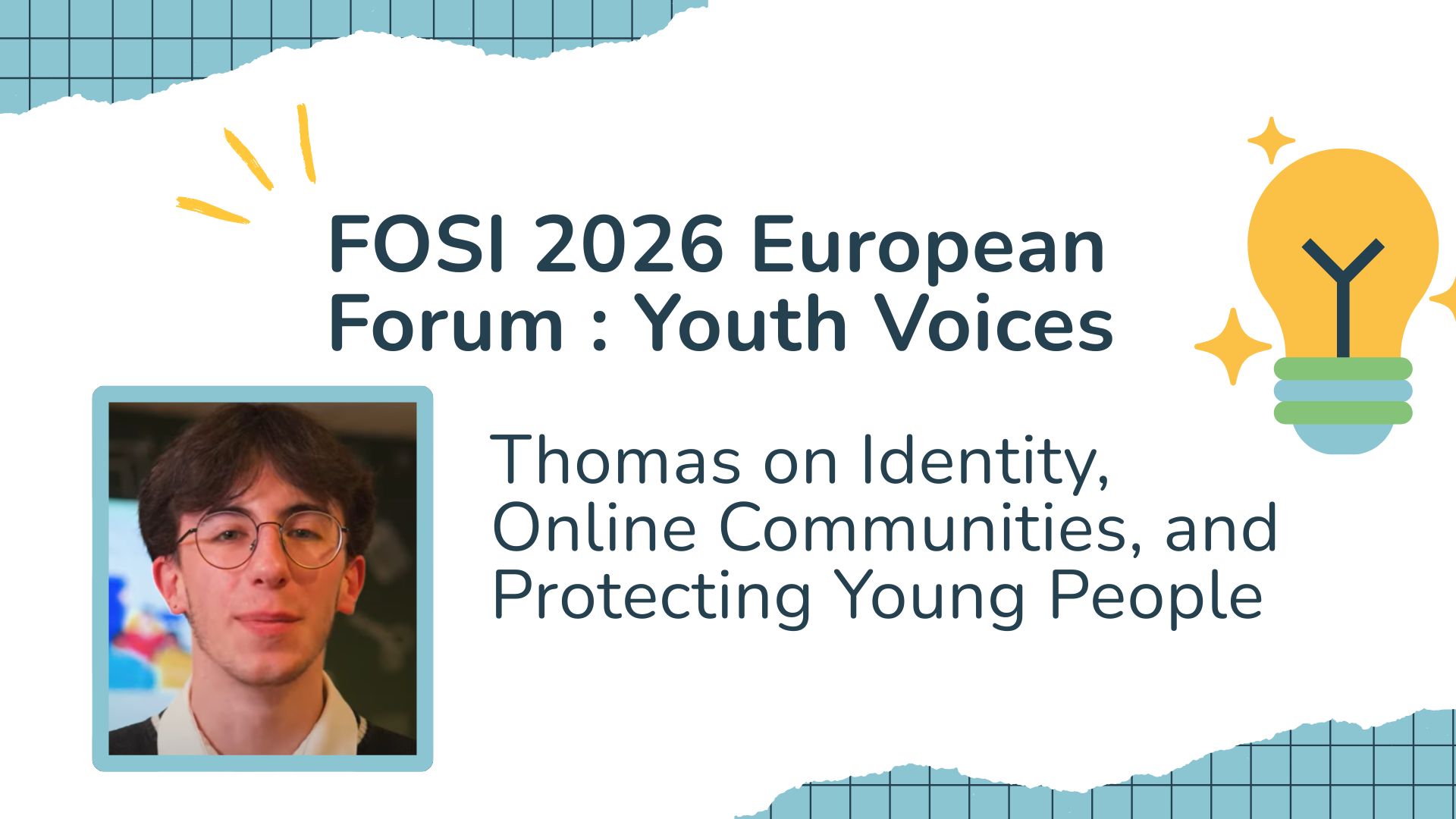
During FOSI’s 2026 European Forum, Thomas joined fellow youth representatives from Child Focus to call for stronger protections for children and greater accountability from platforms. His remarks are shared below.
“My name is Thomas Pierzchlewicz, I am 17 years old, and I come from all corners of Europe. On my father’s side, my family immigrated from Italy and Poland in search of work. On my mother’s side, my grandparents fled Franco’s Spain for the same reasons. This is why I grew up immersed in a Manichean culture torn between my father’s sides’s fervent Protestantism and my mother’s side’s fear of religion. It is this same culture that is certainly at the root of the fact that, in my family, there were subjects we did not talk about — and homosexuality was certainly one of them. So it was only at the age of 10 that I discovered the existence of this word and what it meant, and it was also at the age of 10 that I began to ask myself difficult but necessary questions about the normed and illusory world that had been built, unconsciously, around me from birth.
Seven years later, I can tell you with certainty that I do not know where I would be today in this process of questioning if the internet had not existed. At first, it was a place that frightened me, because the searches I carried out there returned very stereotyped results — and I must admit, this developed within young me an internalized homophobia that made me believe that, since I did not recognize myself in the images I saw, I was not gay. These questions, I could share with no one around me, and my only way out and forward was to join communities on the internet — young boys, like me, who were lost in a world hostile to difference. This is perhaps one of the most beautiful aspects of social media: being able to connect with the world and build relationships with people who are like us, people we could never have met a few decades earlier. But what I did not know — and what almost nobody knew at the time — was that these communities of young gay boys were also hunting grounds for predators: vicious, anonymous adults who could be anyone and anywhere, a neighbor, a stranger, or perhaps even someone in this very room. And the internet, which was supposed to be a protection against paedophilia, had instead become a gift to those same predators.
To understand what I am talking about, we need to go back to the late 1990s. Europe, and in some ways the world, was devastated by what is now known as one of the biggest paedophilia cases in history: the kidnapping of Julie and Melissa by Marc Dutroux. This defining generational event partly gave rise to a collective trauma, and many parents began to let their children play in the street less freely. At that time, many healthcare professionals — who had grown up before the democratization of the internet — tended to view psychological problems as coming either from an external outside world (work, family, etc.) or from an internal inside world (genetics, illness, etc.). However, the confinement of children at home, happening simultaneously with the spread of the internet, opened the world to a new external inside dimension whose strengths and weaknesses were not assessed in time, and whose safety measures were applied far too late — or never at all, in the most lagging spheres.
All of this was meant, as I already said, to protect us from an external outside world, while instead exposing us to a new external inside world that was even more dangerous, being almost unknown and uncontrolled. Generation Z will almost certainly be forever the most affected by these socio-technological shifts.
I will use the time I have left to stress this: acting now to make the internet safer is a matter of public health. Banning social media for under-16s will change nothing — it simply amounts to acknowledging that there is a deep-rooted problem and avoiding it in a hypocritical way. Banning under-16s from social media is like locking the front door and leaving the back door wide open. These kids will find another way in — they always do. What they need is not walls, but guides. Age verification without education is just theatre. And let me tell you about theatre because, in a quest for self-healing and for bringing media attention to this systemic sexual violence still endured by this same group of children set apart for their difference, I wrote a play a year ago called Carné. To write it, I drew partly on my own experience, but above all on the testimonies of hundreds and hundreds of anonymized gay boys from my generation with whom I had the opportunity to speak over several months — almost all of whom share the common thread of trauma from grooming, sextortion, or worse, having their first sexual experience very young with an adult.
And no report, no white paper, no policy brief would have given them a voice. Because this is also a failure of our systems.
This is why — and I speak as a representative of all those voices silenced by shame and distrust in the justice system — I ask you to take action : To all the platforms here — you are not neutral platforms. You are the backseat of adolescence. And right now, that backseat has no seatbelts. I am not asking you to solve loneliness. I am asking you to stop profiting from it, so that one day we may hope that our children can learn to discover who they are in complete safety. I am asking you to build one thing: a button that actually works. A report button that a scared 12-year-old boy can press at 2am and know with certainty that someone will answer.
I am 17. I should not be the one standing here telling you this. But here I am — because no one else did.
Thank you.”