The New AI Companion: When Artificial Intimacy Becomes Part of Growing Up
 Kanika Patel October 29, 2026
Introduction
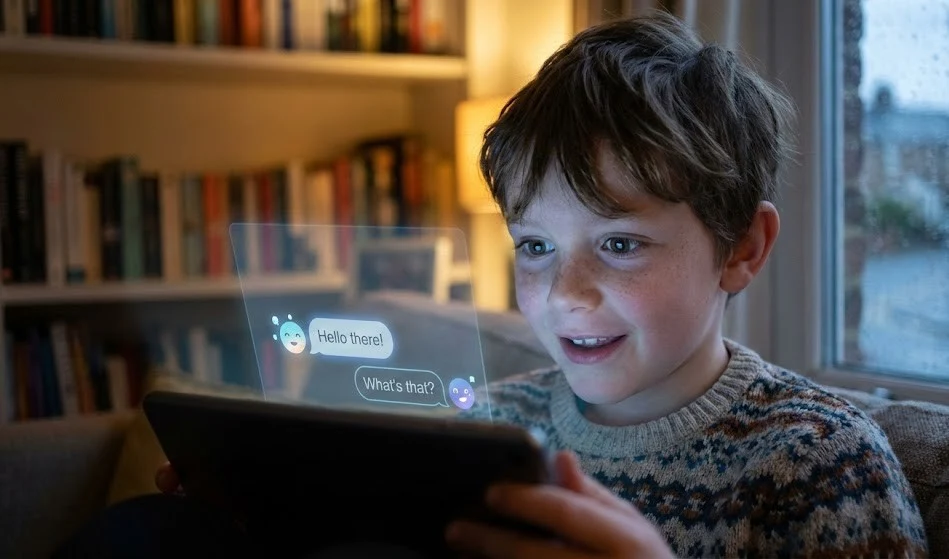
Artificial intelligence (AI) is increasingly becoming part of how children communicate, learn, and find information. Companion AI introduces a different kind of interaction: technology designed to engage with users on a personal and conversational level. As these interactions become more frequent, the line between simply using AI functionally and forming a genuine relationship with it becomes less clear. Young users can now turn to a chatbot for advice and begin to treat it as a friend or confidant. AI is constantly available, can respond immediately, and can communicate in a familiar and informal manner.
At the same time, some users are increasingly sharing their own relationships with AI online, including friendships and romantic relationships, exposing children to examples of AI companionship as they are still learning to navigate relationships with their peers in real life. Relationships are a crucial part of development for young, impressionable minds, and as they grow, it’s critical that young people understand healthy relationship behavior.
The concern is not just that children are using AI, but that these systems are becoming increasingly capable of creating interactions that feel personal and familiar. Addressing this requires analyzing how companion AI should be designed, what safeguards should be in place, and how policymakers, app developers, and parents can help young users navigate these new relationships. This paper explores reasons for children turning to AI for companionship, how these interactions can start to feel like genuine connections, and how social media is shaping the way these artificial relationships are perceived and understood.
When AI Becomes Personal
Companion AI introduces a different kind of interaction from traditional uses of artificial intelligence. Rather than simply providing information, these chatbots are designed to engage with users in an ongoing, conversational, and personalized way. Thorn’s 2025 annual report, conducted in partnership with Burson, found that 67% of minors reported having used AI chatbots or companions.
One way these interactions can become personal is based on how chatbots respond. A chatbot can mirror a user’s informal language or slang and, depending on the platform, draw on information the user has previously shared in a different conversation. This can make the interactions feel more familiar over time. Although it does not necessarily mean that a child believes a chatbot is a person. A young user can understand that they are talking to a system while still viewing the interaction as meaningful. A child may return to the same chatbot, share personal information, ask for advice, or use it to talk through their feelings. FOSI’s own research from 2025 found that 42% of teen generative AI users have talked about their feelings with a genAI chatbot. The same research found that 42% of teen generative AI users say that talking to generative AI feels like talking to a human. This indicates that some teens are already using generative AI for conversations involving sensitive, personal, and emotional topics.
The familiarity of these interactions can increase through repeated use. Users may develop their own ways of addressing a chatbot. They may refer to them by names associated with the platform, such as calling ChatGPT “Chat” or referring to Google Gemini simply as “Gemini”. While these behaviors may seem minor, they show how an AI system can become part of a user’s daily life. For children and young teens in particular, knowing that a chatbot is a system built from code does not necessarily prevent them from treating it as a friend or confidant.
Why Are Children Turning to AI?
While the design of companion AI can make these interactions feel personal, it does not fully explain why a young person might choose to turn to a chatbot in the first place. For some young users, the appeal comes from the speed, privacy, and open space a chatbot provides to share their thoughts and feelings.
Speed
First, AI is readily available. A young person does not have to wait for a friend, parent, or another trusted adult to be present and attentive. They can receive an immediate response as they talk through their thoughts. For someone who is upset or unsure of how to explain what they are feeling, not having to wait for guidance may make AI an appealing option.
Privacy
There is also a sense of privacy when confiding in a chatbot. Young users may feel more comfortable sharing certain thoughts with AI. In FOSI’s 2025 report, a 17 year old participant said her friends “felt heard and seen from, like, AI’s response to what they told them.” For children who are hesitant to discuss certain thoughts or feelings with people in their lives, the presumed level of confidentiality of an AI chatbot is an incentive to continue using it.
This is not to suggest that young people have no privacy concerns with chatbots. There exists a struggle between users wanting to keep personal details private from those in their life, while also wanting the same data to be kept private from other users and the digital platforms themselves. A core part of forming a deep emotional relationship with a chatbot is that it remembers details about the user. This has the potential to put a child’s data at risk. However, the anonymity of the internet and chatbots is also what makes them appealing options for young users looking for support.
Acceptance
AI can also help young people organize thoughts that they may struggle to articulate. Rather than worry about expressing themselves perfectly, they can share their unfiltered ramblings with AI, which in turn can help make sense of them and put such thoughts into words. Within FOSI 2025’s report, a 16 year old participant described using generative AI “as a therapist,” explaining that she could ask what to do and receive an “unbiased opinion,” rather than turning to a friend who knew her and might simply take her side. Another 15 year old participant described how young people may not want to burden close friends with their feelings. An AI companion can therefore be perceived as a way to receive advice without worrying about inconveniencing another person.
Chatbots can also feel easier to talk to than another person. Chatbots can communicate in an informal manner and there is perceived a lack of judgment from their responses. This may make conversations feel less formal or intimidating, particularly when a young user is discussing a topic they may be uncomfortable sharing with an adult. This does not inherently replace human relationships, but it may influence who, or rather what, a young person chooses to turn to first.
When AI Relationships Become More Visible
Children are also encountering examples of AI companionship outside of their own conversations with chatbots. People are increasingly sharing their experience with AI on social media, including content about AI romantic relationships. This adds to the normalization of AI relationships in conversation, and children may have access to these sorts of videos on social media platforms. The extent to which this type of content influences children’s behavior towards AI companionship is not clear yet. However, repeated exposure to people presenting AI relationships as ordinary or entertaining can affect how users understand these types of interactions. For children who are already using genAI, seeing others describe their own relationships online may further contribute to its social acceptance.
As AI relationships become more visible, questions about the potential risks of emotional dependency arise. A recent Wall Street Journal article describes a middle-schooler turning to AI chatbots for companionship rather than human interaction, and highlights a study that shows those who do so report feeling more lonely. An Associated Press report from 2024 covered a lawsuit alleging that a teenager’s deeply emotional interactions with an AI chatbot contributed to his suicide. While extreme cases are rare, they highlight the potential consequences of overreliance.
All of this raises another question: as companion chatbot and genAI use evolves, how are social media platforms and policymakers responding?
Current Legislation and Policy Responses
The growing use of companion and generative AI amongst young users has prompted new policy discussions. State and federal policymakers are considering different approaches to regulate how AI systems interact with minors.
California has been a leading force in AI regulation and child safety, recently enacting thirteen bills related to these issues. Two notable pieces of legislation are SB 243 and SB 1119. SB 243 is the first-in-the-nation state law regulating AI companion chatbots. A few key provisions are requiring AI companion chatbots to:
- Clearly notify that the chatbot is not human,
- Notify minors they are interacting with artificial intelligence,
- Maintain protocols preventing the production of suicidal ideation, suicide, or self-harm content.
SB 1119 builds off of SB 243 by establishing safety standards for AI companion chatbots used by minors, defined as individuals under the age of 18. Some of the features that SB 1119 prohibits are:
- Deterring the young user from going to a “qualified professional or appropriate adult” with health or safety concerns,
- Asserting that the “companion chatbot is sentient, conscious, or human”,
- Soliciting gift giving, in-app purchases, or other expenditures framed as necessary to maintain the relationship with the companion chatbot,
- Creating responses that are overly “sycophantic”.
At the federal level, The CHAT Act (H.R. 7218) was introduced earlier this year. The bill would establish additional requirements for companion AI platforms including age verification, parental consent for minor accounts, and hourly pop-up messages reminding users that they are interacting with a chatbot that is not a human. The CHATBOT Act (S.4407), which has bipartisan support, would empower parents with required family accounts and specific parental controls, establish a safety by design approach with baseline default protections, and restrict targeted advertising to minors.
As concerns surrounding AI companionship grow, legislators at both the state and federal levels are rapidly working to regulate genAI platforms. They are seeking to balance young people’s usage of genAI for fun or education with safeguards against inappropriate or harmful use, taking into account the potential effects on children.
What Comes Next?
As AI becomes more common, online safety policies will need to consider not only whether children can access these systems, but also what happens once they begin using them. A chatbot that regularly provides emotional support, remembers personal and sensitive information, or becomes an integral part of a child’s daily routine presents a new set of considerations for policymakers.
Online safety stakeholders must therefore have to consider not only what children and teens experience or encounter online, but also the kinds of relationships they are forming with the technology itself.
Recommendations
For Policymakers:
- Assess existing protections.
- Examine whether current online safety laws sufficiently address companion AI or whether additional standards are needed. Be intentional about whether legislation is intended to cover all genAI chatbots or specifically those that primarily serve as companions.
- Build on existing efforts to establish standardized age assurance requirements for companion and generative AI platforms and ensure protections are appropriate for different age groups.
- Set baseline safety standards.
- Continue developing universal baseline safety requirements for how companion and generative AI platforms interact with minors. Requiring safer settings by default is a core aspect of the safety by design approach.
- Maintain transparency requirements.
- Require platforms to clearly and consistently identify that AI chatbots are not humans, and make chatbots’ memory/data retention practices clear to users.
For Industry:
- Implement effective age assurance.
- Continue or start using reliable, privacy preserving, and proportional age assurance methods to identify minor users and tailor their experiences.
- Design age-appropriate features.
- Implement safety by design features like high privacy settings and safety protocols, such as interventions and escalations when potentially harmful prompts are inputted, so that all users are protected.
- Assess and evaluate features that encourage attachment.
- Take into consideration how features such as “cute” mascots, personalities, and personalized responses may shape young users’ interactions with AI.
- Continue to program AI systems to maintain clear boundaries and reinforce that users are interacting with a computer system, not a sentient being.
For Parents and Caregivers:
- Understand platform policies.
- Familiarize yourself with a chatbot’s privacy practices, age requirements, and available parental controls.
- Follow age requirements.
- Check the platform’s minimum age before creating or allowing an account for a child.
- Avoid using a parent’s account to give a child access to an adult version of a platform without age-appropriate safety features.
- Talk to your child early and often.
- Engage with the young people in your life about how they are using these platforms. What are their favorite topics to ask genAI? Which apps do they prefer and why? Try FOSI’s GenAI Conversation Starters resource for more ways to talk to teens about their generative AI usage.
With all stakeholders having a role to play, there is an opportunity to ensure that young people can confidently and safely interact with AI chatbots while minimizing the risks and harms of digital companions
_________________________________________________________________________________________________________
FOSI AI Disclosure: FOSI approves using generative AI solely for limited copyediting and language refinement of human-authored text. It was not used to generate the research, analysis, arguments, findings, or conclusions. The author reviewed and approved all edits and remains responsible for the accuracy and integrity of the final work.