Three Questions to Ask When You’re Worried About Your Teen’s Phone Habits
 Dr. Jacqueline Vickery April 23, 2026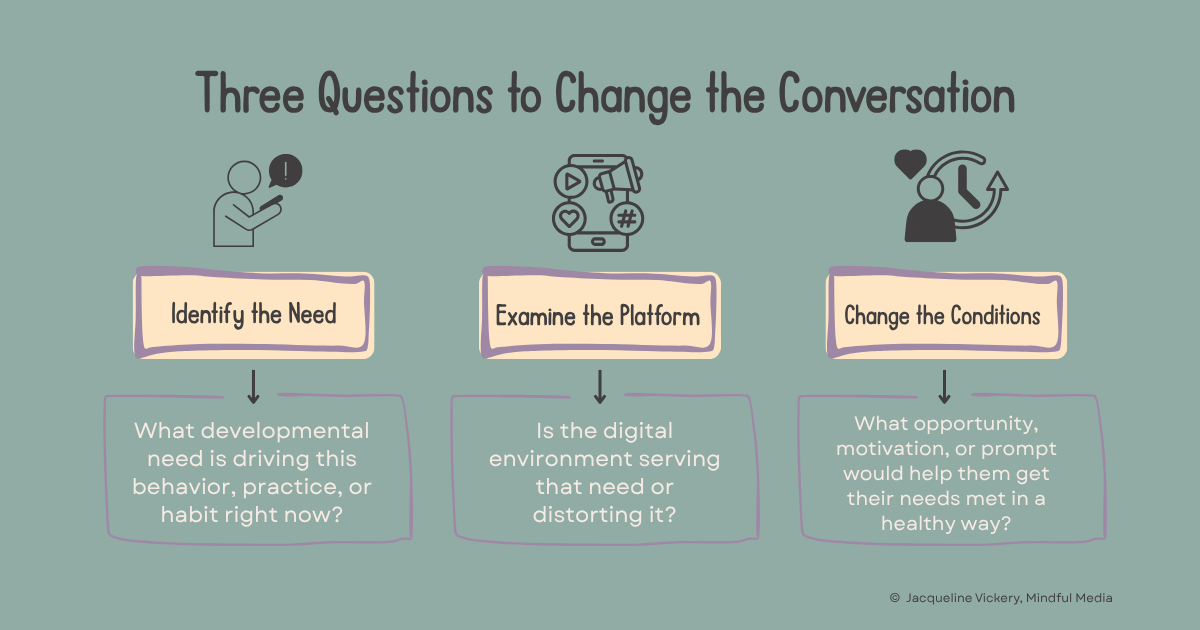
When a teen’s phone use starts to worry their caregivers – the irritability after scrolling, the sneaking it after bedtime, the constant negotiations – it can be hard to know what to do about it. Often the go-to response is to reach for a rule. Rules serve a purpose and some structure around phone use is useful, but a rule aimed at behavior doesn’t tell you anything about what’s driving the behavior.
Often, the reason is that we’ve misidentified the problem itself:
What caregivers and teens often label phone addiction is more accurately a problematic habit. And the good news is, habits can be changed. Problematic use typically forms around a developmentally appropriate need, but in an environment designed to distort and exploit it.
And so, the path to changing it runs through both: understanding the need underneath the behavior and the platform features keeping it in place.
Three questions that get you there:
Question 1: What does my teen need right now?
Most caregivers understand that teens want to stay in touch with friends or take a break from homework with a game.
But sometimes there are other needs teens might be seeking to meet that are easier to overlook; these matter when a habit develops into a worry.
These might include:
- Autonomy: having a space that’s theirs, not supervised or structured by adults
- Competence: getting good at something, having something to offer
- Belonging: being part of something larger than their immediate world
- Identity: figuring out who they are apart from home or school
None of these needs are new and none of them are problems. What has changed though is the environment where they pursue them.
Many teens use digital media to complement their offline social lives, but for some teens digital spaces are one of the few places these needs get met at all.
Maybe they are supplementing offline lives that don’t offer much unstructured time, unsupervised space, or opportunity to develop a sense of mastery. That’s worth taking seriously, even when the habit is out of balance or the need isn’t being met in a healthy way.
Question 2: Is the digital environment serving the need in a healthy way?
There’s a meaningful difference between a platform that helps a young person connect with people who share their interests and one that finds a need for connection and uses it to keep them scrolling elongated periods.
Some platforms are designed to do the latter because engagement helps the product get sold. A teen seeking connection who ends up doomscrolling through strangers’ content that makes them feel worse didn’t get what they came for.
This matters for how parents talk to their kids. It shifts the questions from “why can’t you just stop?” and “why do you care so much about likes?” to “what were you looking for?” and “is this platform giving it to you?”
That shift moves the conversation away from something being wrong with the user and instead names the platform as the problem.
A few design features worth knowing about:
- Endless scroll and autoplay remove natural stopping points and the decision to continue
- Streaks manufacture social obligation, turning choice into something that feels like a commitment
- Read receipts and online status create immediate pressure to respond
- Notifications make interruptions the default
- In-game rewards create urgency and keep players returning on the platform’s schedule
Naming this gives teens something specific to push back against, which is a more useful starting point than shame or sheer willpower.
Question 3: What change would help them meet their needs in a healthy way?
Once you understand the need, you might find the behavior isn’t as problematic as it looked. But if it is, the question becomes whether the necessary change is about the digital environment, how to meet the need, or both.
Sometimes the change is about structuring the digital environment:
- Setting app timers to create natural stopping points or logging out of apps to create more friction
- Helping a teen intentionally curate a healthier algorithm and feed
- Turning off notifications so interruptions become a choice rather than a default
- Adjusting when, where, and how phones are used in the rhythm of their day
But often the change has nothing to do with the phone at all:
- A teen who needs belonging might need help finding an offline community.
- A teen seeking autonomy might need more unstructured, unsupervised time in their week.
- A teen working on identity or competence might need creative outlets (that aren’t tailored to an algorithm or audience!), new experiences, or simply adults who are curious about who they’re becoming.
This is also where the protective factor of digital literacy comes in:
A teen who understands what the environment was designed to do, knows it can be changed, and intentionally connects their phone use to their broader well-being is in a fundamentally different position than one who believes the difficulty is their own failure.
There are no easy answers and sometimes what looks like a phone problem is a symptom of an unmet need. Knowing how to spot the difference is where healthier habits begin.